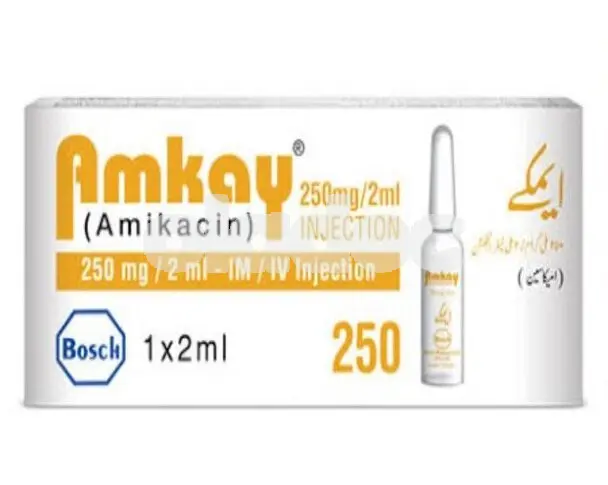
About Amkay Injection 250mg/2ml
Amkay is an aminoglycoside antibiotic injection for severe bacterial infections resistant to other antibiotics.
Amkay Injection 250mg/2ml Uses
- Treats serious Gram-negative bacterial infections of the respiratory tract, including hospital-acquired pneumonia.
- Used for urinary tract infections caused by multidrug-resistant organisms that do not respond to standard antibiotics.
- Manages bacterial infections of the blood (septicemia) particularly involving Pseudomonas aeruginosa, Klebsiella, and Acinetobacter species.
- Treats infected burns, wound infections, and post-surgical bacterial complications involving resistant organisms.
- Used for bacterial infections of the peritoneum (peritonitis) and in combination regimens for endocarditis.
Amkay Injection 250mg/2ml Benefits
- Amikacin retains activity against many Gram-negative organisms resistant to gentamicin and tobramycin, making it a critical last-line antibiotic option.
- Broad-spectrum coverage against a wide range of Gram-negative pathogens including Pseudomonas aeruginosa.
- Can be administered intramuscularly or intravenously, providing flexibility in clinical settings.
- Short treatment courses of 7 to 10 days minimize the risk of dose-related toxicity.
- Long-established clinical record with predictable pharmacokinetics that support therapeutic drug monitoring.
What Experts Say
Infectious disease specialists rely on amikacin as one of the few aminoglycoside antibiotics that retains activity against Gram-negative organisms resistant to gentamicin and tobramycin. This profile makes Amkay particularly valuable in hospital settings managing multidrug-resistant Pseudomonas aeruginosa, Klebsiella, and Acinetobacter infections.
Clinicians administer amikacin intravenously or intramuscularly, with dosing calculated from the patient's weight and renal function. Therapeutic drug monitoring is standard practice during amikacin therapy to ensure peak concentrations are bactericidal while trough levels remain low enough to prevent ototoxicity and nephrotoxicity.
Microbiologists emphasize that amikacin courses are intentionally kept short, typically 7 to 10 days, to minimize cumulative exposure. Extended courses significantly increase the risk of irreversible hearing loss and renal impairment. Amikacin is generally reserved for infections confirmed or strongly suspected to be resistant to beta-lactam alternatives.
Drug Class
- Aminoglycoside antibiotic
Amkay Injection 250mg/2ml Uses in Urdu
Amkay Injection ایک اینٹی بایوٹک انجیکشن ہے جو دوسرے اینٹی بایوٹکس کے خلاف مزاحم شدید بیکٹیریل انفیکشن کے علاج کے لیے ہسپتال میں استعمال ہوتا ہے۔
- شدید بیکٹیریل انفیکشن کا علاج کرتا ہے
- مزاحم گرام منفی بیکٹیریا کے خلاف موثر ہے
- خون کے بیکٹیریل انفیکشن (سیپٹیسیمیا) کا علاج کرتا ہے
Amkay Injection 250mg/2ml formula
How to use Amkay Injection 250mg/2ml?
- Amkay Injection is administered by a healthcare professional via intramuscular (IM) or intravenous (IV) injection. Do not self-administer.
- Dosage is calculated based on the patient's body weight (typically 15mg/kg/day) and kidney function, divided into doses every 8 to 12 hours as prescribed by the physician.
- For IV administration, dilute in an appropriate IV fluid and infuse over 30 to 60 minutes. Do not administer as a rapid IV bolus.
- Complete the full prescribed course even if symptoms improve. Stopping treatment early can lead to antibiotic resistance.
- Kidney function and hearing should be monitored regularly during the course of treatment, especially in patients receiving extended therapy.
Drug Interactions
Amkay Injection may interact with several drugs used in hospital settings. The prescribing physician should review all concurrent medications before initiating therapy.
- Loop diuretics (furosemide, ethacrynic acid): Significantly increase the risk of ototoxicity and nephrotoxicity when used concurrently with amikacin. Avoid this combination if possible.
- Other nephrotoxic agents (vancomycin, amphotericin B, cisplatin): Additive renal toxicity risk. Close monitoring of kidney function is mandatory.
- Neuromuscular blocking agents (vecuronium, atracurium): Amikacin may enhance their effects. Inform the anesthesiologist of amikacin use before any procedure involving these drugs.
- Penicillins and cephalosporins: Physically incompatible in the same IV line — do not mix in the same solution or infuse simultaneously.
Risks and warnings
- Nephrotoxicity: Amikacin can cause kidney damage, particularly with high doses, prolonged use, or in patients with pre-existing renal impairment. Monitor renal function regularly.
- Ototoxicity: Amikacin can cause irreversible hearing loss or balance disturbances. Risk increases with high doses, prolonged therapy, and concurrent use of loop diuretics.
- Neuromuscular blockade: Amikacin may enhance the effects of neuromuscular blocking agents used during surgery. Inform your anesthesiologist before any planned procedure.
- Allergy: Do not use if the patient is allergic to amikacin or other aminoglycoside antibiotics.
- Pregnancy: Aminoglycosides can cause irreversible hearing damage in the developing fetus. Use only when no safer alternative exists, with close monitoring.
Amkay Injection 250mg/2ml Side Effects
Amkay Injection is administered in clinical settings under medical supervision. Side effects are dose-related and monitored during treatment.
- Pain or discomfort at the injection site with intramuscular administration
- Nausea or mild gastrointestinal disturbance
- Elevated creatinine or reduced urine output indicating early renal stress
- Mild dizziness or unsteadiness
The following effects are serious and may be dose-limiting or irreversible.
- Ototoxicity: ringing in the ears (tinnitus), reduced hearing acuity, or balance disturbances — discontinue and consult the physician immediately
- Nephrotoxicity: significant rise in creatinine, reduced urine output, or signs of acute kidney injury — requires dose reduction or discontinuation
- Respiratory muscle weakness or apnea in patients receiving concurrent neuromuscular blocking agents
Storage Conditions
- Store between 15°C and 30°C, protected from direct light and heat. Do not refrigerate amikacin injection ampoules.
- Single-use ampoule only — discard any unused solution immediately after administration. Do not store a partially used ampoule for later use.
- Inspect the ampoule before use. Do not use if the solution contains particles, appears discolored, or if the ampoule seal is broken.
- Keep ampoules in their original carton to protect from light exposure during storage.
- Store out of reach of children. Check the expiry date before each use and discard any expired ampoules.