

Book Appointment with the best "Cardiologists"
Book AppointmentChest pain is frightening. The first thought that comes to most people’s mind is, “Is this a heart attack?” Sometimes it is. Most of the time, though, the pain comes from somewhere else, such as acidity, gas, a pulled muscle or stress. In Urdu, it is simply called seene mein dard.
Chest pain causes fall into two broad groups. Heart causes include a heart attack, angina and swelling around the heart. Non-heart causes include acid reflux, gas, gallstones, lung problems like pneumonia, sore chest muscles, anxiety and shingles.
Some of these causes can be life-threatening, so one rule matters more than anything else in this guide. If chest pain is new, heavy or crushing, or it comes with breathlessness, sweating or pain spreading to your arm or jaw, call Rescue 1122 straight away.
Below, you will find each cause explained in plain words, how the pain usually feels, what its location can tell you, and when to see a doctor.
Key Takeaways
- Chest pain can come from the heart, lungs, food pipe and stomach, chest muscles and ribs, nerves, or anxiety.
- Most chest pain is not caused by the heart, but a heart attack, a blood clot in the lungs and a tear in the main artery can be deadly, so new or severe pain needs urgent care.
- Heart pain often feels like pressure, squeezing or heaviness and may spread to the arm, jaw, neck or back.
- Pain that gets worse when you press on your chest, breathe deeply or change position, or comes with a sour taste, is more often from a non-heart cause.
- Women, older adults and people with diabetes may have a heart attack with little chest pain, feeling only breathless, sick or very tired.
- An ECG and a troponin blood test are usually the first tests doctors use to check whether chest pain is coming from the heart.
What Is Chest Pain And How Does It Feel?
Chest pain is any pain or discomfort between your neck and your upper belly. It can feel sharp, dull, burning, crushing, tight or like pressure.
It may last a few seconds or several hours, and it can spread to your arms, back, neck or jaw. How it feels gives useful clues, but it cannot confirm the cause on its own.
People describe it in very different ways. Some feel a heavy weight sitting on the chest, others a tight band, a stabbing pain when they breathe in, or a burning feeling behind the breastbone after a meal.
What Is Chest Pain Called In Urdu?
Chest pain in Urdu is seene mein dard (سینے میں درد). Pain on the left side is often called baen taraf seene mein dard (بائیں طرف سینے میں درد). When people suspect the heart, they may also say dil ka dard.
What Are The Main Causes Of Chest Pain?
The main causes of chest pain are heart problems (heart attack, angina, pericarditis), digestive problems (acid reflux, gas, ulcers, gallstones), lung problems (pneumonia, pleurisy, a blood clot in the lungs, asthma), muscle and bone problems (muscle strain, costochondritis, rib injury), anxiety or panic attacks, and nerve problems such as shingles.
Here is some good news. According to a study on emergency room chest pain published in the Journal of Emergency Medicine, 80% to 95% of people who come to the emergency department with chest pain turn out not to have heart disease or another heart or lung emergency.
That does not mean chest pain can be ignored. The serious causes can look a lot like the harmless ones, which is why doctors always rule out the dangerous ones first.
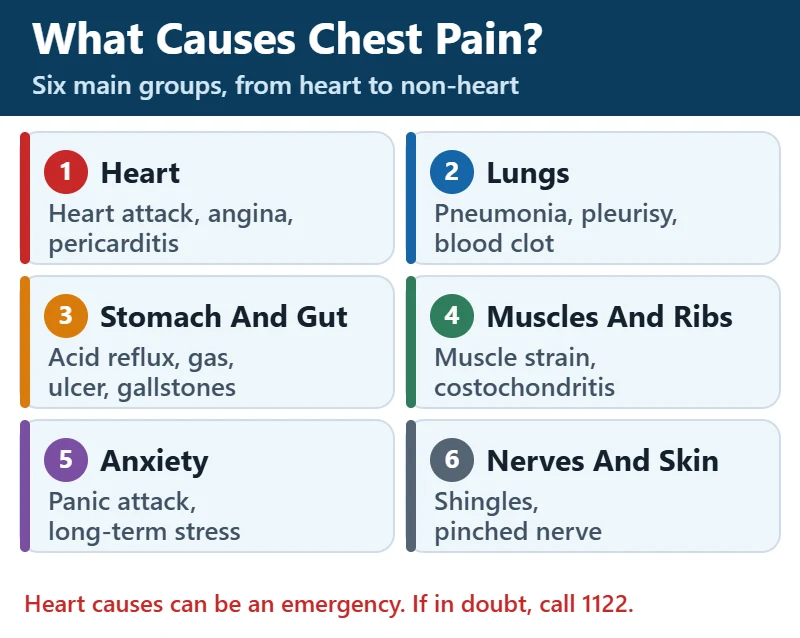
This quick table shows the common causes, how they usually feel and how urgent they are:
| Cause | How It Often Feels | How Urgent |
|---|---|---|
| Heart attack | Pressure, squeezing or heaviness lasting more than a few minutes, often with sweating or breathlessness | Emergency |
| Angina | Tightness during effort, stress or cold weather that settles with rest | See a cardiologist soon, and treat it as an emergency if it starts at rest |
| Pericarditis | Sharp pain, worse when lying flat or breathing in, better when leaning forward | Same-day check |
| Aortic dissection | Sudden, severe tearing pain that may go through to the back | Emergency |
| Acid reflux (GERD) | Burning behind the breastbone after meals or when lying down, sour taste | Book an appointment if it keeps coming back |
| Gas or indigestion | Bloating, burping and cramp-like pain that moves around | Usually not urgent |
| Gallstones | Steady pain in the upper right belly that can spread to the chest or right shoulder, often after oily food | Same-day check if severe |
| Pneumonia or pleurisy | Sharp pain when breathing in or coughing, often with fever and cough | Same-day check |
| Blood clot in the lungs | Sudden sharp pain with breathlessness and a fast heartbeat | Emergency |
| Collapsed lung | Sudden pain on one side with breathlessness | Emergency |
| Muscle strain or costochondritis | A sore spot that hurts when pressed, when you twist or when you lift | Usually not urgent |
| Panic attack | Sudden fear, racing heart, fast breathing and tingling hands | Get checked the first time it happens |
| Shingles | Burning pain on one side, then a band of blisters | See a doctor within a day or two |
Use this table as a guide, not a diagnosis. Only a doctor can tell these causes apart, and often only with tests.
Which Heart Problems Cause Chest Pain?
Heart-related chest pain is most often caused by coronary artery disease, where narrowed arteries cannot bring enough blood to the heart muscle. This leads to angina or a heart attack.
Other heart causes include swelling of the sac around the heart (pericarditis), swelling of the heart muscle (myocarditis), heart valve problems and, rarely, a tear in the aorta.
This matters a great deal in Pakistan. WHO estimates show that ischaemic heart disease is the leading cause of death in the country, and South Asians tend to develop heart disease at a younger age than many other groups.
Is It A Heart Attack?
A heart attack happens when a blood clot suddenly blocks an artery that feeds the heart. Part of the heart muscle starts to die within minutes, so every minute of delay matters.
The pain usually sits in the centre of the chest and feels like pressure, squeezing, fullness or a heavy weight. It may last more than a few minutes, or go away and come back. The American Heart Association lists these other warning signs:
- Pain or discomfort in one or both arms, the back, neck, jaw or stomach
- Shortness of breath, with or without chest pain
- A cold sweat
- Nausea or vomiting
- Light-headedness or unusual tiredness
Some heart attacks are sudden and intense. Many others start slowly with mild pain, so don’t wait to see if it passes. You can read about heart attack treatment options and how to prevent a heart attack in the first place.
What Is Angina And How Does It Feel?
Angina is chest pain that happens when the heart muscle does not get enough oxygen-rich blood, usually because its arteries have narrowed.
Stable angina comes on with effort, such as climbing stairs, walking fast or carrying heavy shopping. A big meal, cold weather or stress can also set it off, and it settles within a few minutes of rest.
Unstable angina is different. It comes on at rest, lasts longer or keeps getting worse, and it can mean a heart attack is close. Treat it as an emergency.
To learn more, read why angina makes your heart hurt, or this Urdu guide on angina ke dard ka ilaj.
Can Swelling Around The Heart Cause Chest Pain?
Yes. Pericarditis is swelling of the thin sac around the heart. It often follows a viral infection and causes a sharp, stabbing pain behind the breastbone. The pain usually gets worse when you breathe in or lie flat, and eases when you sit up and lean forward.
Myocarditis, which is swelling of the heart muscle itself, can cause chest pain, breathlessness and a racing heartbeat, sometimes after a viral illness. Both need a doctor’s check the same day.
What Other Heart Problems Can Cause Chest Pain?
- Aortic dissection: a tear in the wall of the aorta, the body’s main artery. It causes sudden, severe pain that people describe as tearing or ripping, often going through to the back. It is rare but life-threatening, and uncontrolled high blood pressure is its biggest risk factor.
- Heart valve disease: a narrowed valve, for example after rheumatic fever in childhood, can cause chest pain on effort along with breathlessness or fainting.
- Hypertrophic cardiomyopathy: an inherited thickening of the heart muscle that can cause chest pain during exercise, even in young people.
- Broken heart syndrome: sudden severe stress, such as grief, can weaken the heart muscle for a while and cause pain that feels like a heart attack. Here is how broken heart syndrome is treated.
What Are The Non-Heart Causes Of Chest Pain?
The most common non-heart causes of chest pain are acid reflux and other food pipe problems, gas and indigestion, sore chest muscles or swollen rib cartilage, lung infections, and anxiety or panic attacks.
Less common ones include gallstones, stomach ulcers, a blood clot in the lungs, a collapsed lung and shingles.
Keep in mind that “non-heart” does not always mean harmless. A blood clot in the lungs or a collapsed lung is just as urgent as a heart attack.
Can Acidity Or Gas Cause Chest Pain?
Yes. Acid reflux, also called GERD, is one of the most common reasons for chest pain that is not from the heart.
Stomach acid flows back up into the food pipe, which runs right behind the heart, and causes a burning feeling behind the breastbone. This is the seene ki jalan many people feel after a heavy meal.
These clues point towards acid reflux:
- Burning that starts after eating, especially oily, spicy or late-night meals like nihari, paye or biryani
- Pain that gets worse when you lie down or bend over
- A sour or bitter taste in your mouth, burping, or food coming back up
- Relief after taking an antacid
Trapped gas can also cause sharp, cramp-like pain in the chest or upper belly, often with bloating and burping. It tends to move around and ease once the gas passes. These quick ways to relieve stomach gas can help.
Spasms of the food pipe are another cause. They can bring on a squeezing pain that feels very much like angina, and trouble swallowing is often a clue.
One word of caution. Heart pain can also feel like burning, and feeling better after an antacid does not rule out the heart. If you are over 40, smoke, or have diabetes or high blood pressure, get checked before you decide it is just gas.
For reflux that keeps coming back, see a doctor about GERD treatment. You can also read this Urdu guide on seene ki jalan ka ilaj.
Can Gallstones Or A Stomach Ulcer Cause Chest Pain?
Yes. Gallstones can block the bile duct and cause a gallbladder attack. This is a strong, steady pain in the upper right belly or just below the breastbone, and it can spread to the chest, back or right shoulder. It often starts after a fatty meal and can last for hours. Here is what to do during a gallbladder attack.
A stomach ulcer causes a gnawing or burning pain in the upper belly that can rise into the lower chest. Painkillers like ibuprofen and an H. pylori infection are common causes. Learn the signs of a stomach ulcer.
Swelling of the pancreas (pancreatitis) can also cause severe upper belly pain that spreads to the back and chest, often with vomiting.
Which Lung Problems Cause Chest Pain?
Lung-related chest pain usually feels sharp and gets worse when you breathe in deeply, cough or sneeze. The common causes are:
- Pneumonia: a lung infection with fever, a cough with phlegm, breathlessness and sharp pain on breathing. Read more about pneumonia symptoms and recovery.
- Pleurisy: swelling of the lining around the lungs, often after a viral infection, which gives a stabbing pain with each breath.
- Pulmonary embolism: a blood clot that travels to the lungs. It causes sudden sharp chest pain, breathlessness, a fast heartbeat and sometimes coughing up blood. Long journeys, recent surgery, pregnancy and some hormone pills raise the risk. This is an emergency. See doctors who treat pulmonary embolism.
- Collapsed lung (pneumothorax): air leaks into the space around the lung, causing sudden pain on one side and breathlessness. It is more common in tall, thin young men and in smokers.
- Asthma and COPD: these cause chest tightness along with wheezing and coughing. In Lahore and other cities of Punjab, the winter smog season makes flare-ups more common. Here is how to stay safe from smog if you have asthma.
Can A Pulled Muscle Or Rib Problem Cause Chest Pain?
Yes, and this is one of the most common causes of all. The chest wall is made of muscles, ribs and cartilage, and any of them can get sore.
- Muscle strain: from lifting something heavy, a new workout, or hard coughing during a cold or chest infection.
- Costochondritis: swelling of the cartilage that joins the ribs to the breastbone. It causes sharp pain, most often on the left side, and can feel a lot like a heart attack.
- Rib injury: a bruised or cracked rib after a fall or an accident.
The biggest clue is that chest wall pain usually hurts more when you press on the spot, twist, lift your arms or take a deep breath. It often lasts for days rather than minutes. Rest and a warm compress usually help.
Ask a doctor or pharmacist which painkiller is safe for you, as some are not suitable for people with stomach, kidney or heart problems.
Can Anxiety Or A Panic Attack Cause Chest Pain?
Yes. During a panic attack, the body’s alarm system switches on. Your heart races, you breathe fast, your chest muscles tighten, and you may feel sharp or tight chest pain along with tingling hands, sweating, dizziness and a sense of doom. It usually peaks within about 10 minutes.
Ongoing stress and anxiety can also cause chest tightness that comes and goes on most days.
These are real physical symptoms, not something you are imagining. Read about the physical symptoms of anxiety and how to calm a panic attack.
A panic attack and a heart attack can look alike. If it is your first episode, or it feels different from usual, get checked. If panic attacks keep coming back, a psychiatrist in Islamabad or your own city can help.
What Other Conditions Can Cause Chest Pain?
- Shingles: the chickenpox virus can wake up years later and cause burning or tingling pain on one side of the chest, followed a few days later by a band of blisters. Early antiviral treatment helps.
- A pinched nerve in the upper back or neck, which can send pain around to the chest.
- Breast pain in women, which can be linked to periods, breastfeeding or a breast infection.
- Long-term pain conditions such as fibromyalgia.
How Can You Tell If Chest Pain Is From The Heart?
Heart pain more often feels like pressure, squeezing or heaviness in the centre or left of the chest. It tends to come on with effort or stress and may spread to the arm, jaw, neck or back, with sweating or breathlessness.
Non-heart pain is more often sharp, linked to breathing, movement or meals, and sore when pressed. Only tests can confirm the cause.
The clues below follow the ones listed by Mayo Clinic:
| Clue | More Likely Heart | More Likely Non-Heart |
|---|---|---|
| How it feels | Pressure, squeezing, heaviness or tightness | Sharp, stabbing, burning or sore |
| What sets it off | Effort, cold weather, stress or a heavy meal | Eating, lying down, breathing in, coughing or twisting |
| Where it spreads | Arm, shoulder, jaw, neck, back or upper belly | Usually stays in one spot |
| Pressing on the chest | Makes no difference | Makes it hurt more |
| How long it lasts | A few minutes in angina, longer in a heart attack | A few seconds, or many hours to days |
| Other signs | Sweating, breathlessness, nausea or dizziness | Sour taste, trouble swallowing, cough, fever or a rash |
These are only clues. Burning pain behind the breastbone can come from either the heart or the stomach. Heart attacks in women, older adults and people with diabetes can also feel mild or unusual. When in doubt, get it checked.
What Does The Location Of Chest Pain Tell You?
The location of chest pain gives a hint, but it cannot tell you the cause for sure. Heart pain is often felt in the centre or on the left. Right-sided pain is more often from the lungs, muscles or gallbladder. Pain behind the breastbone is common with both acid reflux and heart problems.
What Causes Left Side Chest Pain?
Left side chest pain worries people the most because the heart sits slightly to the left. It can be angina or a heart attack. It is also often caused by costochondritis, a strained muscle, gas trapped in the upper bowel, a lung infection or collapsed lung on that side, or anxiety.
Pain that spreads to the left arm or jaw, or comes with breathlessness and sweating, needs emergency care.
What Causes Right Side Chest Pain?
Right side chest pain is less often from the heart, although a heart attack can still cause it. Common causes are a strained muscle, costochondritis, pneumonia or pleurisy in the right lung, a blood clot in the lungs, gallstones and liver problems. Shingles can affect either side.
What Causes Pain In The Middle Of The Chest?
Pain in the middle of the chest, behind the breastbone, is the classic spot for both heart attack pain and acid reflux. It can also come from food pipe spasms, pericarditis or costochondritis.
Because the heart and the food pipe sit so close together, never brush off central chest pain as gas without a check, especially if you have risk factors for heart disease.
What Causes Chest Pain In Women?
Women get chest pain from the same causes as men, including heart disease. During a heart attack, though, women more often have other symptoms too, such as breathlessness, nausea, vomiting, back or jaw pain and unusual tiredness. Breast pain, hormone changes and pregnancy can also cause chest discomfort.
Heart disease in women is often missed in Pakistan. A study published in JACC: Asia in February 2026 found that Pakistani women had the highest death rate from ischaemic heart disease among women in five South Asian countries. Diabetes, high blood pressure, weight gain and too little exercise all raise the risk.
Other reasons women may feel chest pain include:
- Breast pain before a period, during breastfeeding or with a breast infection
- Heartburn during pregnancy, as hormones relax the valve at the top of the stomach
- Anxiety and panic attacks, which are more common in women
- A higher risk of heart disease after menopause, which makes any new chest pain worth taking seriously
Many women delay getting help because they believe heart attacks mostly happen to men. If you notice the warning signs, call for help without waiting.
When Is Chest Pain An Emergency?
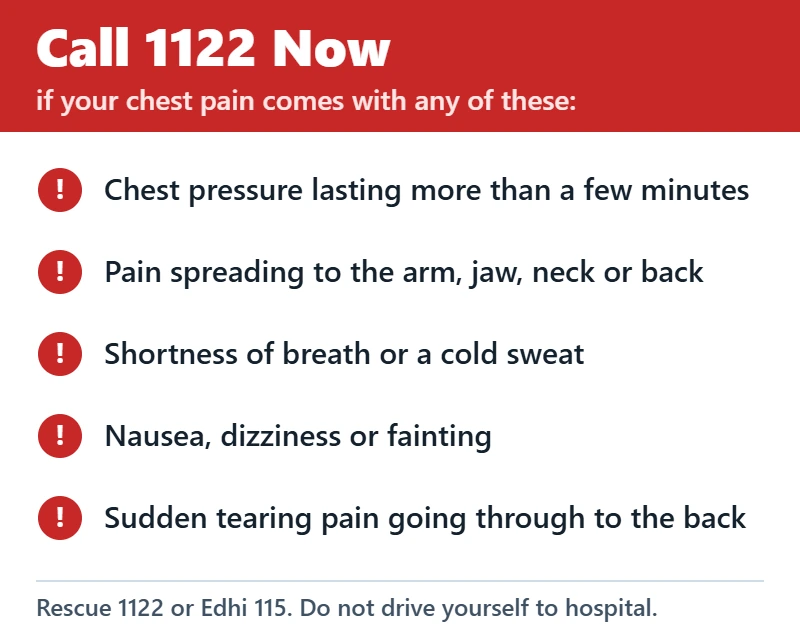
Chest pain is an emergency if it is sudden, severe or crushing, lasts more than a few minutes, or comes with breathlessness, sweating, nausea, fainting, or pain spreading to the arm, jaw, neck or back. Call Rescue 1122 or Edhi (115) for an ambulance straight away, and don’t drive yourself to the hospital.
When Should You Call An Ambulance?
- Pressure, squeezing or heaviness in the chest that lasts more than a few minutes, or keeps coming back
- Pain spreading to one or both arms, the jaw, neck or back
- Shortness of breath, a cold sweat, nausea, dizziness or fainting
- Sudden, severe tearing pain that goes through to the back
- Sudden sharp pain with breathlessness, especially after a long journey, surgery or childbirth
- Coughing up blood
- Angina pain that starts at rest, or doesn’t settle with rest or your usual medicine
What Should You Do While Waiting For Help?
- Stop what you are doing and sit down in a comfortable position, usually half sitting up.
- Loosen tight clothing and try to stay calm.
- If a doctor has prescribed a nitroglycerin (GTN) spray or tablet for angina, use it as you were told.
- Ask the ambulance team or a doctor on the phone whether you should chew an aspirin. It helps in a heart attack, but it can do harm if the pain is from a bleeding ulcer or a torn aorta. Never take it if you are allergic to it.
- If the person collapses and is not breathing normally, start CPR by pushing hard and fast in the centre of the chest until help arrives.
When Should You Book A Doctor’s Appointment?
See a doctor within a day or two if:
- Chest pain comes and goes over days or weeks
- You feel chest tightness during effort that settles with rest, which can be stable angina
- Burning chest pain keeps coming back after meals
- You have chest pain with a fever and cough
- A painful rash appears on one side of your chest
- Chest pain keeps returning and you don’t know why
Which Doctor Should You See For Chest Pain?
For sudden or severe chest pain, go straight to the emergency department. For chest pain that comes and goes, a cardiologist is the best first stop if your heart could be involved, especially if you are over 40, smoke, or have diabetes, high blood pressure or high cholesterol. A general physician can also check you and refer you on.
Depending on the likely cause, you may need:
- A cardiologist for suspected heart pain. Book a cardiologist in Lahore or a heart specialist in Karachi, and find out when you should see a cardiologist.
- A gastroenterologist for acidity, ulcers, swallowing trouble or gallstones. You can book a gastroenterologist in Lahore.
- A pulmonologist for cough, breathlessness, asthma or a chest infection, such as a chest specialist in Karachi.
- A psychiatrist or psychologist for panic attacks that keep coming back.
- A general physician in Lahore or your city for a first check if you are not sure where to start.
For pain that comes and goes, you can start with an online consultation with a heart specialist on oladoc. Sudden or severe pain still needs in-person emergency care.
How Do Doctors Find The Cause Of Chest Pain?
Doctors start by ruling out the dangerous causes. They ask about your pain, check your blood pressure, pulse and oxygen level, and usually do an ECG and a troponin blood test within minutes. Depending on the results, you may need a chest X-ray, an echocardiogram, a stress test, a CT scan or an endoscopy.
The tests you may hear about include:
- ECG (electrocardiogram): records the heart’s electrical activity and can show a heart attack or a rhythm problem within minutes. You can book an ECG test on oladoc.
- Troponin blood test: troponin leaks into the blood when heart muscle is damaged, and the test is often repeated after a few hours. Here is more on the troponin I test.
- Chest X-ray: checks for pneumonia, a collapsed lung and other lung problems.
- Echocardiogram: an ultrasound of the heart that shows how well it pumps and how the valves work. Read about the echo test and how an echo differs from an ECG.
- Exercise tolerance test (ETT): checks your heart while you walk on a treadmill.
- CT scan: a CT coronary angiogram looks at the heart arteries, while a CT pulmonary angiogram looks for a clot in the lungs.
- Other blood tests: such as D-dimer for clots, plus cholesterol, blood sugar and a full blood count.
- Endoscopy: a thin camera checks the food pipe and stomach if reflux or an ulcer is suspected.
- Abdominal ultrasound: looks for gallstones.
A normal ECG does not always rule out the heart, especially early on or between episodes of angina. That is why doctors may repeat it or add other tests.
How Is Chest Pain Treated?
Chest pain treatment depends on the cause. A heart attack needs emergency treatment to open the blocked artery, often with angioplasty and a stent. Angina is treated with medicines and lifestyle changes. Acid reflux improves with antacids and acid-lowering medicines, chest wall pain with rest and pain relief, and bacterial pneumonia with antibiotics.
- Heart attack and unstable angina: clot-preventing medicines, and angioplasty with a stent or sometimes bypass surgery.
- Stable angina: medicines your cardiologist prescribes to ease the pain and protect the heart, along with lifestyle changes.
- Acid reflux: antacids, acid-lowering medicines, and avoiding late, heavy meals.
- Pneumonia: antibiotics when the infection is bacterial.
- Blood clot in the lungs: blood thinners, given in hospital.
- Panic attacks: breathing techniques, talking therapy and sometimes medicine.
Is There A Tablet For Chest Pain?
There is no single chest pain tablet that works for every cause, so don’t self-medicate. Antacids won’t help heart pain, and heart medicines won’t help a pulled muscle. Painkillers like ibuprofen or diclofenac can irritate the stomach and are not safe for everyone with heart or kidney problems. See a doctor first, so the medicine matches the cause.
How Can You Lower Your Risk Of Heart-Related Chest Pain?
You can lower your risk of heart-related chest pain by not smoking, keeping your blood pressure, blood sugar and cholesterol under control, staying active, keeping a healthy weight, and eating less salt, oil and sugar. Regular check-ups matter, because high blood pressure and diabetes often cause no symptoms until damage is done.
- Stop smoking, including shisha, chewing tobacco and naswar. Here is how tobacco harms hearts in Pakistan.
- Get your blood pressure, blood sugar and cholesterol checked regularly, and start early if heart disease runs in your family.
- Walk briskly for at least 30 minutes on most days.
- Cut down on fried food, ghee, salty snacks and sugary drinks.
- Manage stress and get enough sleep.
To ease chest pain from reflux, eat smaller meals, leave 2 to 3 hours between dinner and bed, and cut back on spicy and oily food, strong tea and fizzy drinks.
What Else Do People Ask About Chest Pain?
What Are 5 Common Causes Of Chest Pain?
Five common causes of chest pain are acid reflux, muscle strain or costochondritis, anxiety or panic attacks, angina or a heart attack, and lung infections such as pneumonia. Gas, gallstones and shingles are other frequent reasons. Because a heart attack is on this list, new chest pain should always be checked.
How Do I Know If My Chest Pain Is Serious?
Chest pain is serious if it feels crushing or heavy, lasts more than a few minutes, or comes with breathlessness, sweating, nausea, dizziness, or pain in the arm, jaw or back. Sudden tearing pain, or sudden pain with breathlessness, is also an emergency. If you are unsure, treat it as serious and call 1122.
What Can I Drink To Stop Chest Pain?
No drink can stop heart-related chest pain, so don’t try home remedies if your heart could be the cause. If you are sure the pain is from acidity, sipping water or taking an antacid may ease the burning. Avoid strong tea, coffee, fizzy drinks and alcohol, which can make reflux worse.
Can Gas Cause Pain On The Left Side Of The Chest?
Yes. Gas trapped in the upper part of the large bowel, under the left ribs, can cause sharp pain in the left side of the chest. It usually comes with bloating and eases after burping or passing wind. Because the heart is also on the left, get checked if the pain is new, heavy or spreads to your arm or jaw.
Can Stress Cause Chest Pain Every Day?
Yes. Long-term stress and anxiety can cause chest tightness or aching on most days, often from tense chest muscles and fast, shallow breathing. Even so, daily chest pain should be checked by a doctor at least once to rule out heart, lung and stomach causes before you put it down to stress.
Why Does My Chest Hurt When I Breathe In?
Pain that gets worse when you breathe in usually comes from the lungs or the chest wall, such as pleurisy, pneumonia, a strained muscle or costochondritis. Pericarditis can do this too. Sudden pain on breathing with breathlessness can mean a blood clot or a collapsed lung, which needs emergency care.
How Long Does Chest Muscle Pain Last?
A mild chest muscle strain usually gets better within a few days to 2 weeks with rest. Costochondritis can last for weeks and sometimes longer. If the pain is getting worse, comes with breathlessness or doesn’t improve after a couple of weeks, see a doctor.
Can Young People Get Chest Pain From The Heart?
Yes, although it is less common. Smoking, diabetes, high cholesterol, a strong family history, drug use or an inherited heart condition can cause heart problems at a young age. In young people, though, chest pain is much more often from muscles, acidity or anxiety.
Why Do I Get Chest Pain When Lying Down At Night?
Chest pain that starts when you lie down is often from acid reflux, because acid flows up more easily when you are flat. Pericarditis also hurts more when lying back. Chest pain that wakes you from sleep can be a sign of unstable angina, so it needs urgent care.
So, Should You Worry About Chest Pain?
Most chest pain is not a heart attack. Acidity, gas, sore muscles and stress cause a lot of it. But you can’t safely tell the difference at home, and the serious causes need help fast. If the pain is new, heavy or spreading, or comes with breathlessness or sweating, call 1122. If it comes and goes, see a cardiologist and get simple tests like an ECG. Peace of mind is worth the visit.
Where Does This Information Come From?
- Chest Pain: Symptoms and Causes. Mayo Clinic.
- Warning Signs of a Heart Attack. American Heart Association.
- Musey PI, Kline JA. Emergency Department Cardiopulmonary Evaluation of Low-Risk Chest Pain Patients With Self-Reported Stress and Anxiety. Journal of Emergency Medicine, 2017.
- Global Health Estimates 2021: Leading Causes of Death in Pakistan. World Health Organization.
Disclaimer: The contents of this article are intended to raise awareness about common health issues and should not be viewed as sound medical advice for your specific condition. You should always consult with a licensed medical practitioner prior to following any suggestions outlined in this article or adopting any treatment protocol based on the contents of this article.